Rodent infestations in Davidson County operate on seasonal biological pressures that exploit the architectural vulnerabilities of local architecture. Historic brick foundations in Germantown and the stone stem-walls…
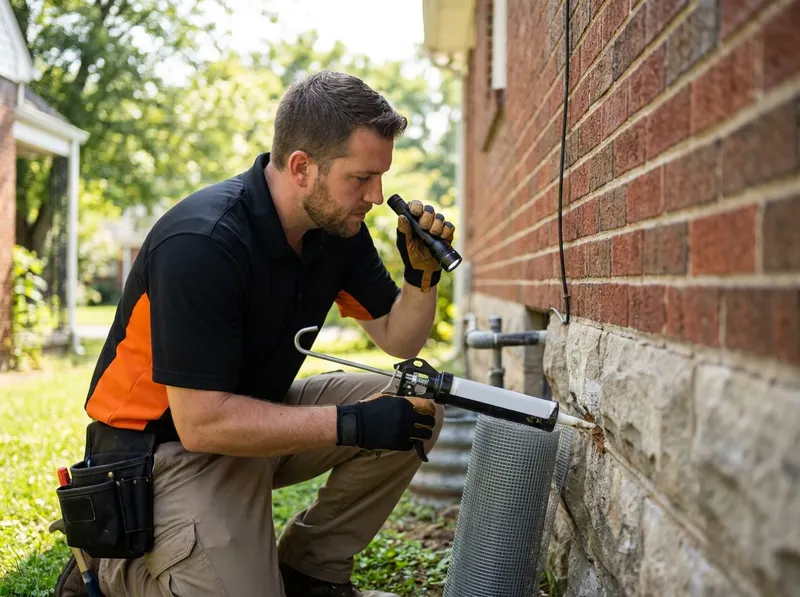
Rodent infestations in Davidson County operate on seasonal biological pressures that exploit the architectural vulnerabilities of local architecture. Historic brick foundations in Germantown and the stone stem-walls common in Belmont-Hillsboro frequently develop perimeter gaps where mortar degrades over decades, allowing field rodents direct passage into crawlspaces. In modernized renovations throughout The Nations, 12 South, and East Nashville, contractors often cut oversized penetrations for plumbing rough-ins, HVAC line sets, and electrical conduits. A standard house mouse requires an opening of merely one-quarter inch, the diameter of a standard pencil, to squeeze into wall voids, while adult roof rats bypass foundation perimeters through gaps as small as one-half inch. The Centers for Disease Control and Prevention guidance on sealing pests establishes that physical exclusion is the only sustainable strategy for halting structural rodent invasions, as broadcast poisons outside structural envelopes merely create localized attractants while risking secondary poisoning in local wildlife and domestic pets.
The technical difference between basic extermination and comprehensive exclusion centers on architectural permanence. Standard bait placement kills isolated foragers but leaves open thermal conduits through which regional colonies continuously repopulate. Effective perimeter defense utilizes 19-gauge galvanized welded ASTM International standard hardware cloth, non-corrosive copper mesh, and elastomeric structural sealants anchored into masonry and timber sub-framing. In heavily wooded parcels bordering Shelby Bottoms Greenway in Inglewood or riparian corridors along Mill Creek in Donelson, black roof rats exploit overhanging oak branches to access fascia boards, roof returns, and passive attic louver vents. Defending these roof-line junctions demands custom-bent aluminum flashing and metal screening secured across soffit openings, denying canopy-dwelling rodents overhead entry. Technicians applying exclusion principles follow strict integrated methods aligned with the EPA integrated pest management principles, focusing primarily on structural denial rather than repetitive chemical applications.
Interior abatement operates under strict non-chemical extraction protocols inside heated living envelopes. Snap traps, mechanical run-through traps, and sensor-monitored capture assemblies are installed directly along confirmed travel rub-marks, joist plates, and droppings corridors inside attics and crawlspace tracks. Trapping continues until diagnostic monitors show zero disturbance for five consecutive nights, proving the internal breeding cycle is broken. Following population eradication, the threat shifts to residual airborne contaminants. Rodent urine pillars and fecal matter carry biological pathogens that desiccate and circulate through HVAC returns. Technicians conduct HEPA vacuuming alongside natural bio-enzyme applications formulated to dissolve mammalian pheromone trails that draw transient rodents to the home exterior. Property owners seeking local agricultural insight often turn to the University of Tennessee Agricultural Extension wildlife damage manuals to identify regional rodent foraging behaviors that trigger seasonal winter indoor migrations.
Decision-fit for rodent defense requires evaluating the structural condition of the building envelope against the intensity of the infestation. Homes in Green Hills and Sylvan Park with continuous poured-concrete foundations and sound crawlspace vapor barriers often need targeted threshold retrofits, such as installing steel-reinforced door sweeps and exterior crawlspace door latches. Conversely, homes elevated on pier-and-beam foundations require comprehensive crawlspace perimeter skirt installations, wire-mesh subterranean apron burial, and complete ductwork encasement. While a basic trapping regimen presents a lower upfront commitment, trapping without structural exclusion creates a perpetual maintenance treadmill where fresh litters penetrate the building within weeks. Structural exclusion requires an initial material and labor investment but definitively terminates structural entry, preventing recurring structural damage to electrical wiring, PEX water lines, and fiberglass insulation battings.
Every job gets a firm, written price after a free on-site visit.
Tell us about your rodent exclusion and abatement job in Nashville and we'll send a clear, written quote, usually the same day.
 Pest Control Service