Subterranean humidity in Davidson County creates ideal nesting grounds for wood-destroying organisms. Homes across historic areas like East Nashville, Belmont-Hillsboro, and Germantown frequently sit atop damp…
Subterranean humidity in Davidson County creates ideal nesting grounds for wood-destroying organisms. Homes across historic areas like East Nashville, Belmont-Hillsboro, and Germantown frequently sit atop damp limestone crawlspaces that draw rising damp directly into structural floor joists. According to testing standards from the Oak Ridge National Laboratory, unsealed foundation vents channel warm, moist outside air into cooler crawlspaces, raising the relative humidity above 70%. When wood moisture content crosses 19%, fungal organisms colonize subfloors, and eastern subterranean termites exploit the softened framing. The United States Environmental Protection Agency confirms that unmanaged foundation air infiltrates up to 50% of the first-floor breathing air through the structural stack effect.
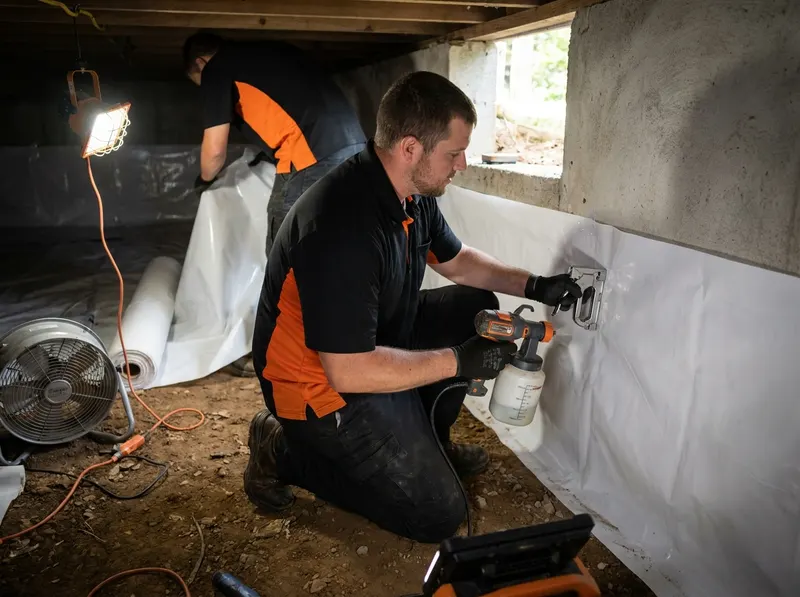
Remediation prioritizes structural integrity over passive cosmetic patches. In neighborhoods with high water tables and dense clay soils, such as Inglewood, Donelson, and Sylvan Park, a bare dirt floor constantly evaporates groundwater into foundation sills. Technicians follow structural guidelines from the Building Science Corporation to arrest this moisture migration. Crews install tear-resistant, puncture-proof liners manufactured according to ASTM International tensile benchmarks, anchoring the seams directly to perimeter foundation walls using non-corrosive fasteners. Foundation guidelines established by the U.S. Department of Energy show that sealing foundation vents combined with mechanical humidity control stabilizes crawlspace relative humidity between 45% and 55% year-round.
Managing subfloor moisture also eliminates active harborage for brown recluse spiders, camel crickets, and subterranean termites. By pairing containment poly with sealed access doors compliant with the International Code Council residential codes, ground vapor is permanently separated from the subfloor framing. Heavy-duty units engineered under Association of Home Appliance Manufacturers standards extract excess dampness without toxic airborne sprays or off-gassing chemicals, ensuring safety for households with small children and pets. This mechanical setup adheres to regional housing directives outlined by the U.S. Department of Housing and Urban Development while meeting indoor air purity thresholds documented by the Centers for Disease Control and Prevention and the National Institute of Environmental Health Sciences.
The initial process begins with an on-site structural moisture mapping: (1) Technicians record pin-probe subfloor moisture percentages and foundation wall dampness. (2) Crews remove failing fiberglass batts, rotted cellulose, and localized pest-attracting detritus. (3) Structural specialists fit heavy-gauge multi-mil containment sheets across dirt floors, sealing all piers and edges. (4) Foundation wall vents are sealed to prevent outdoor humidity intrusion. (5) An automatic continuous-drainage dehumidifier is installed to maintain subfloor moisture levels well below the 15% termite survival threshold.
Every job gets a firm, written price after a free on-site visit.
Tell us about your crawlspace vapor and moisture remediation job in Nashville and we'll send a clear, written quote, usually the same day.
 Pest Control Service