Brown recluse spiders (Loxosceles reclusa) represent an entrenched biological challenge in Middle Tennessee, thriving inside the dark voids, framing gaps, and insulated attics of historical bungalows in East Nashville,…
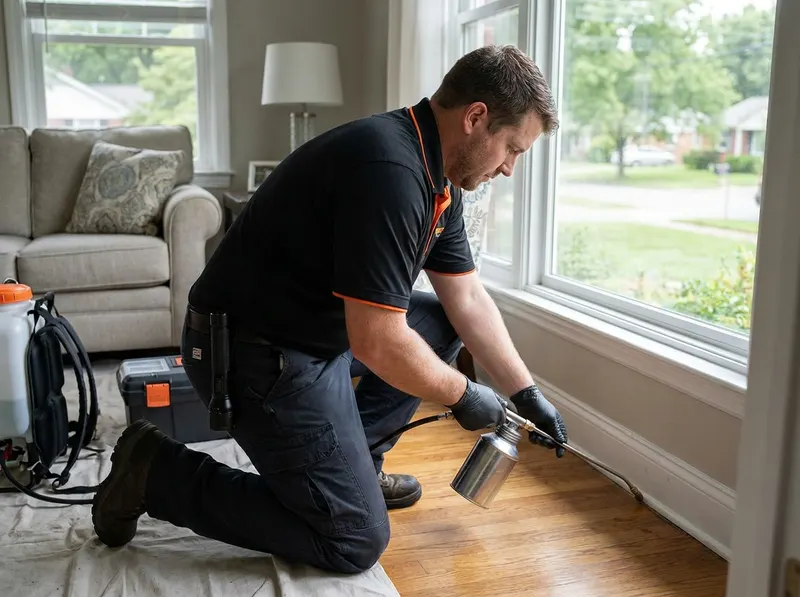
Brown recluse spiders (Loxosceles reclusa) represent an entrenched biological challenge in Middle Tennessee, thriving inside the dark voids, framing gaps, and insulated attics of historical bungalows in East Nashville, Sylvan Park, and Belmont-Hillsboro. Standard broad-spectrum repellent sprays often fail because recluses walk on the tips of their tarsi, minimizing contact with treated surfaces. Remediation requires an integrated approach defined by structural physics and insect biology. Technicians inject inorganic desiccant dusts, such as synthetic amorphous silica registered by the U.S. Environmental Protection Agency, directly into electrical switchplates, baseboard channels, and attic trusses where spiders shelter during daylight hours. Residual applications along foundational sill plates adhere to guidelines established by the Tennessee Department of Agriculture to establish non-repellent mortality zones that do not push populations deeper into living areas.
Crawlspace humidity and secondary insect infestations directly sustain brown recluse colonies. In neighborhoods near waterway corridors like Shelby Bottoms Greenway or the low-elevation soils around Donelson and Inglewood, foundation vents allow moisture to accumulate, attracting silverfish, crickets, and booklice. Pest Control Service eliminates this primary food web by pairing crawlspace remediation with moisture management guidelines supported by the U.S. Department of Housing and Urban Development. Crawlspace ground barriers, pipe-penetration seals, and targeted residual applications conform to standards from the National Pest Management Association. Furthermore, applications around structural HVAC trunk lines comply with airflow safety standards established by the American Society of Heating, Refrigerating and Air-Conditioning Engineers to safeguard indoor breathing air across finished living spaces in Green Hills and 12 South.
Effective containment relies on strict technical calibration rather than over-saturating living areas with liquid chemicals. Technicians deploy industrial-grade polybutene sticky boards, referenced for population density tracking by the University of Kentucky Department of Entomology and research published through the Entomological Society of America. Monitoring grids isolate the core breeding epicenters, often unfinished basements, subflooring, or cedar-shake roof layers common in Germantown and The Nations. Structural barrier work coordinates with the pest safety specifications of the Occupational Safety and Health Administration to ensure crawlspace and attic structural integrity during application. Follow-up treatments align with biological incubation cycles identified by the University of Tennessee Extension, ensuring newly hatched spiderlings contact active residual barriers before reaching reproductive maturity. Technical consultations can be arranged by calling (629) 319-7851.
Every job gets a firm, written price after a free on-site visit.
Tell us about your brown recluse spider remediation job in Nashville and we'll send a clear, written quote, usually the same day.
 Pest Control Service