Nashville mosquito and exterior tick suppression pricing and property parameters Residential barrier programs require a minimum investment of $300 per treatment cycle for residential lots up to 0.25 acres. Standard…
<h2>Nashville mosquito and exterior tick suppression pricing and property parameters</h2>
Residential barrier programs require a minimum investment of $300 per treatment cycle for residential lots up to 0.25 acres. Standard single-family parcels across Green Hills and Belmont-Hillsboro with mature canopy cover range between $350 and $475 per application. Acreage properties exceeding 0.5 acres along the Tennessee Valley Authority drainage easements or near the Cumberland River Compact watershed zones calibrate upward based on linear barrier perimeter needs and dense underbrush management. Seasonal suppression protocols operate on a recurring 21-to-30-day treatment interval from April through October, matching the active breeding cycles dictated by regional humidity and ambient soil temperatures. Pricing remains transparent with no mandatory auto-renewing multi-year service contracts; billing proceeds per scheduled application or via single upfront multi-month seasonal programs.
<h2>Suppression protocols for adult vectors and aquatic breeding zones</h2>
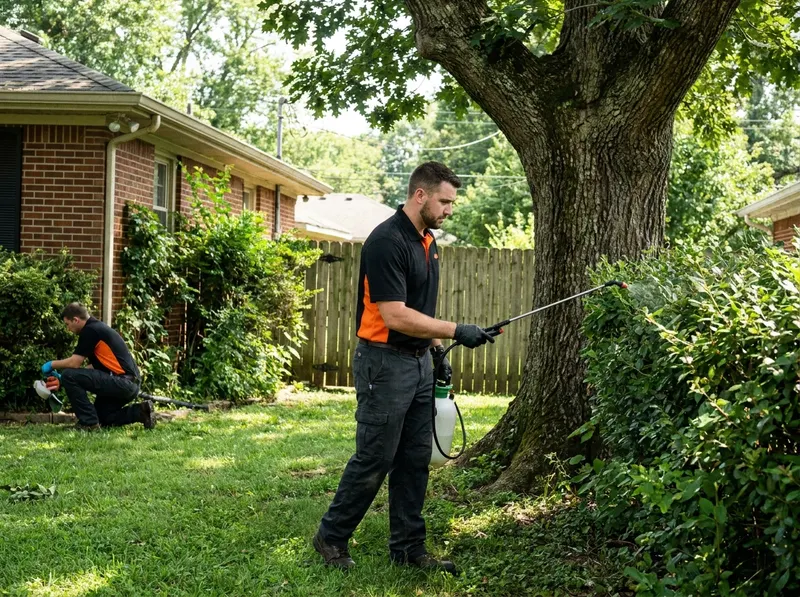
Suppression begins with high-pressure mist-blower delivery of micro-encapsulated adulticides directly to resting harborage zones on the undersides of broadleaf shrubs, deciduous ornamental canopy lower tiers, and dense groundcovers like English ivy. These active agents bind to vertical foliage, providing up to 28 days of residual knockdown. Standing water that cannot be physically drained, such as retention catch basins, low foundation swales, and decorative water installations, is treated using biological Bacillus thuringiensis israelensis (BTI) briquettes. This biological larvicide disrupts early larval digestive tracts within 24 hours without impacting companion animals, local wildlife, or non-target aquatic organisms, adhering to foundational environmental mandates from the Tennessee Department of Agriculture.
<h2>Tick habitat disruption along woodland margins and property borders</h2>
Tick suppression requires distinct mechanical focus along ecotone edges, the transitional boundary between manicured turfgrass and overgrown brush, decorative mulch beds, or native woodland lines. Granular or low-drift liquid acaricide applications are concentrated into dense leaf litter, brush piles, and shade margins where immature nymphs and questing adult lone star ticks congregate. According to surveillance directives from the Centers for Disease Control and Prevention, eliminating tick vectors along domestic borders drastically reduces direct exposure to vector-borne pathogens, including Lyme disease and spotted fever group rickettsioses. Properties in Inglewood, Donelson, and Sylvan Park backing up to unmanaged greenbelts receive dense border barriers extending 10 feet outward from turf margins directly into timber perimeters.
<h2>Local environmental factors driving Nashville vector density</h2>
Davidson County experiences heavy summer precipitation, limestone karst topography with shallow drainage, and extended periods of humidity exceeding 70 percent. These exact geographic characteristics foster severe biological pressure from both Aedes albopictus and Culex mosquitoes. The Metro Public Health Department routinely monitors local mosquito pools for West Nile virus activity, reinforcing the operational necessity of comprehensive perimeter control. In dense urban micro-climates like East Nashville, Germantown, and The Nations, narrow lot spacing and shaded brick courtyards create stagnant air pockets where flying pests rest during peak daylight hours. Properties proximate to parklands like Centennial Park or shaded greenways encounter elevated wildlife vectors including white-tailed deer and urban raccoons, which consistently seed lone star and dog ticks into backyards.
<h2>Technical execution sequence and domestic barrier defense</h2>
Direct professional treatments coordinate through the central technical service dispatch at (629) 319-7851. Operational field measures conform fully with National Pest Management Association technical standards and local municipal statutes under the Federal Insecticide, Fungicide, and Rodenticide Act.
Every job gets a firm, written price after a free on-site visit.
Tell us about your mosquito and exterior tick suppression job in Nashville and we'll send a clear, written quote, usually the same day.
 Pest Control Service